

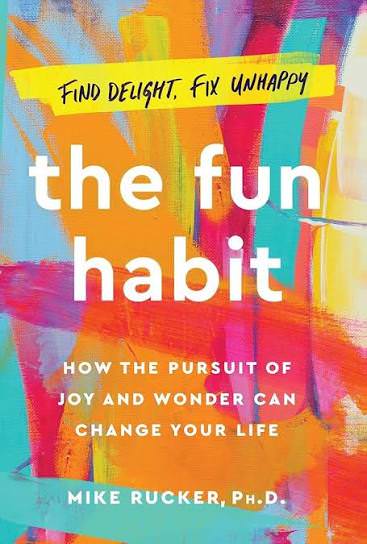
I have always strived to live my live as deliberately and intentionally as possible. This book aligned with my goals to not just live life, but to thrive and enjoy and savor it!
I want to make better choices in the present moment, use my time to take action, and have fun.
Happiness is a Learned Skill
There is no one-way to “solve” the happiness problem for good. Many products and organizations attempt and advertise to, but it is just not possible. We think that if only we can activate our “happiness switch”, then other challenges in life will lose their edge.
Pursuing happiness in and of itself can be a trap. When we are chasing towards happiness, it makes us anything but happy. You chase that fleeting gratification; it’s easy to access and enjoyable, so you return for more, again and again. Sounds a bit like a budding addiction doesn’t it? Emerging science suggest these practices are changing the structure of our brain and making us more prone to depression and anxiety.
“We struggle endlessly with the effort of becoming and then staying happy without ever questioning the value of the effort itself.”
Happiness vs. Having Fun
You can’t always make yourself happy, but you can almost always have fun. Unlike happiness, fun isn’t a reaction to your circumstances. It is an action orientation, one you can control and can enact almost anywhere, anytime.
Whereas when you focus on fun, you are making a conscious decision to adopt a bias towards fun in the life you have now, not some fantasy of tomorrow.
Happiness is a subjectively self-absorbed construct defined by human perception. Fun is demonstrable, observable, real, and immediately in our grasp. It is primal and universal, operating at a level deeper than culture—a fact that’s readily evident when you remember that many animals seek fun, not just humans.
When focusing on happiness, it’s usually a focus on the lack thereof. When we concern ourselves with “becoming” more happy, by proxy we are subconsciously identifying ourselves as unhappy (or at best not happy enough). When this gap within ourselves—his lagging indicator of well-being—becomes our focus, part of our identity, it crowds out the empowering belief that we actually have agency regarding how we spend our time.
“Simply learning to have more fun is a great thing, but using fun to develop your curiosity turns fun’s power into something amazing.”
The Happiness Comparison
We are good at comparing. Feeling happy can often have less to do with our actual experience, and more to do with how we think it compares to someone else’s.
Happiness also naturally leans towards comparison — today’s version of ourselves to yesterday’s version, or comparing ourselves to the Joneses next door. We fixate on that gap between where we are and where we think we’ll be happy. But when you instead deliberately make decisions to have fun, we are more present and moving toward meaningful experiences that really feed us and help us grow.
Most of us try to keep up with the Joneses, one way or the other, but the actual Joneses we compare ourselves to tend to change as our status evolves. Unless you take deliberate action to circumvent this cycle, your rat race will never end.
“Happiness becomes a mirage that we can only see clearly from a distance; once we arrive, we discover there’s not much there—and start to scan the horizon again in what ultimately becomes an infinite loop.”
“Happiness is a state of mind, but fun is something you can do. It doesn’t require education, money, or power. All it requires is intentionality. If happiness is a mirage, fun is your backyard oasis.”
Study after study confirms that our subjective happiness is influenced not only by how much we have (absolute levels of income and position) but how we compare ourselves to others (relative levels of income and position). This phenomenon is known as “positionality.”
“Adaptation to satisfaction can be counteracted by constantly being aware of how fortunate one’s condition is.”
Children & Fun
Kids embrace fun naturally, but as adults we face three obstacles: We’re conditioned as we age to believe that trying to have fun is childish, even inappropriate. We undervalue the mental and physical benefits of fun. We’re put off by the counterintuitive fact that fun for busy adults requires discipline, which sounds… well, not fun.
There was a study done that showed children had the most fun when they were allowed to take responsibility and make choices on their projects.
Fun and play are at the root of how we make sense of the world during early development.
The Hedonic Treadmill | Hedonic Adaptation
Hedonic Adaptation is the brain’s tendency to “set” our enjoyment level.
You initially enjoyed the pleasure of being rewarded for your hard work, the higher income, and the upward shift in social status. Then your situation lost its luster. The familiar yearning for something more returned. That initial high of satisfaction faded, and you were back on the hedonic treadmill.
We are very good at adapting. Any outcome in life, good or bad, generally has a limited, temporary impact on our subjective happiness. Meaning, we eventually acclimate to our new reality and return to whatever default level of happiness we were originally accustomed to, a happiness set point we each individually have.
They have studied this in many ways, including those who win the lottery and you would assume would live a much happier life after a life-changing event. Those positive aspects of these experiences prove ephemeral, and we return to our original state (that pesky happiness set point) or sometimes feel even worse.
“When we actively seek out meaningful social interaction with others through fun, we escape the need for dopamine’s IV drip. As such, fun is an antidote to the hedonic treadmill, enriching our lives instead of simply repressing our true need to feel alive and connected.”
Fun is Biased Toward Action
What does it mean to bias ourselves towards fun? It is another way of saying we restack the deck in our favor for more positive experiences. Fun is less think and more do. You’re either having fun or you’re not.
Fun transports you outside yourself. It is inclusive. It’s not reliant on the “put your mask on first” attitude that many who focus on happiness convey. Fun includes all and a sense of togetheredness.
It’s important to realize a lot of the happiness “prescriptions” out there only offer you a map. When fun burns brightest, when it is supporting our growth, it is generally because we have thrown out the map in order to explore the territory.
When we engage in peak experiential activity, often triggered by challenge, risk, physical exertion, natural wonder, rich insight, or deep personal interactions, the payoff is significant.
“Where happiness has a lot to do about your rank, fun is more about finding fit—connecting you with what’s out there. It’s you and others, or you and the environment, interacting in a harmonious way. Where happiness is very much a me proposition, I’ve found that fun is very often a we proposition.”
The “we” here simply meaning allowing pleasure to be derived from something outside ourselves.
The Nothing
In this book, “the Nothing” is referenced frequently as that black sucking hole that we give our time and energy towards that gives us nothing in return.
Reminiscing | Dispositional Gratitude
Reminiscing is extending fun’s power beyond the moment it occurs. I want you to be able to make the most of your memories, both positive and negative, so that they contribute as much as possible to your well-being even years after the fun.
For example, so many can barely recall their wedding day. The best piece of advice I ever got in this regard was to constantly check in with myself that day, to notice my own feelings and elation amidst the joyful pandemonium. To take the time to take mental pictures.
Relishing the memories we make comes with a host of psychological benefits. And when we document our positive emotions it will have long-term adaptive benefits as well.
Gratefully reminiscing about fond memories is gratitude on steroids, employing a form of appreciation known as dispositional gratitude. Dispositional gratitude is characterized by (1) an appreciation for others, (2) an appreciation for simple pleasures, and (3) a sense of abundance.
Storing Memories
- Journaling is an extremely efficient and effective way for us to store memories and process our experiences, synthesizing events and activities into a coherent narrative
- Instead of keeping a formal journal, write down short stories or vignettes describing your favorite moments and keep them in a folder, adding new ones as you go along
- Any type of themed photo album
- You could also make an expensive archival copy of a really important event that stays on the shelf, alongside a cheaper version appropriate for sticky-fingered children.
Glancing at a photo is good. Using it as the launching point to mentally relive a fun day is even better. Make time to look through some old photos, reach out to friends to let them know you’re thinking of a good time you all once had, or simply schedule a short break to relish a fun thing you did over the weekend.
“The experiences we focus on are at the core of who we are, what we become, and how we perceive the world around us.”
Time
Time is a finite resource, of course, so building time affluence means finding ways to increase the amount of time you have control over.
Intentionality is the ultimate goal, not hyper-optimization of time usage.
When you fill your life with fun and novel experiences and feed your brain lots of new information—learning, traveling, meeting new people, trying new activities—you look back on life in general with greater satisfaction. Neuroscientist David Eagleman describes time as a rubbery thing that can stretch when our brains are fully switched on.
Four Ways We Spend Time
Our activities throughout our life are divided into four quadrants: pleasing, living, yielding, and agonizing. Look for ways to increase the pleasing and living while minimizing the yielding and agonizing activities.
One of the most pervasive, common, and wasteful Yielding activity: mindless consumption of social media, news, and entertainment content. When we find ourselves in neutral or negative valence—in other words, not having fun—vegging out on our phone is often the easiest way to escape our discomfort.
Pleasing Activities
The Compass of Pleasure contends the brain doesn’t know the difference between vice and virtue. We activate the same circuits in the brain when we take heroin or have casual sex as we do when we engage in virtuous acts such as meditating or giving a gift. This could also help explain why fun, which is fundamentally good, can turn bad under circumstances of excess.
Certain activities produce natural feel-good neuro-chemicals like endorphins (e.g., runners get a “runner’s high”). The feeling of euphoria a pleasurable activity produces is compelling, so we gravitate toward it again and again, possibly ignoring all common sense about what’s good for us.
Agonizing Activities
These are the activities we hate to do, but are necessary to being a human and living.
The book suggests you should make a habit of eliminating downtime during Agonizing activities and introduce breaks.
Savor Every Moment
Story Editing
People possess the ability to “edit their personal stories in ways that lead to sustained changes in their behavior and well-being.” People with a growth mindset have an enhanced sense of agency. They see themselves in the driver’s seat of their lives.
What invisible stories about myself and my life have a negative effect on my ability to have fun?
Nate makes a case for the importance of leaving behind the safe, familiar worlds we create for ourselves: “We make our world smaller so we can control it. We make our world simpler so we can understand it. And we reduce ourselves to this diminished scale so we don’t accidentally stray outside this fictionalized world and see the danger—but also the majesty—lurking just beyond the borders of our certainty… The danger is that over time we come to see this pale, anemic version of life as the real thing. We feel the weight of the world but not the wonder, and in time we resign ourselves to one and forget the other.”
The Mystery | Self-Transcendence
The pure joy of leaping from the mundane into the extraordinary.
It’s more when you sense that there’s something so much bigger than you, so much more deep than you are—ancient—has sort of a natural importance that dwarfs your own.”
our ability to connect and learn from the outside world is infinite. The practice affords us the means to transcend our consensus reality for brief moments and absorb ourselves in fascination and wonder—finding beauty in accepting that we will never know everything about anything and just how amazing it is to embrace this truth.
At its best, fun has the power to transcend us to a place beyond valence—a place where joy is limitless because it’s not being fed by the self.
self-transcendence itself, might simply be the skill of truly having fun. Finding wisdom from a much deeper well than what we can create on our own. Being able to lose yourself in an experience, being able to savor the moment without attributing any context. Joy for joy’s sake.